From Signals to Story: Building OpTel Detective
The dashboard is just the surface
Over the past year, I’ve spent a lot of time inside the Operational Telemetry (OpTel) experience, not just looking at it, but working through it by following signals, opening facets, and tracing how one metric connects to another. At a glance, it looks like a dashboard, but it behaves more like a cockpit: something you actively navigate, where each section surfaces a different signal and every interaction adds context.
That depth is what makes OpTel powerful. There is a lot of data, layered in a way that lets you move from high-level trends down to specific contributors. When you spend time with it, a clear picture begins to form. You start to recognize patterns, understand relationships, and see how different signals fit together. Over time, you develop a sense of where to start, what to follow, and how to arrive at a view you can explain clearly to someone else. The system gives you everything you need, but getting to that clarity depends on familiarity and time spent navigating it.
Turning it into something real
After working through this process repeatedly, the flow itself became predictable. The same paths kept showing up, the same signals needed to be cross-referenced, and the same kind of reasoning was required to move from raw data to something coherent. Once you’ve gone through it enough times, you start to see that it’s actually a process.
That’s when it clicked. If this process could be learned, it could also be replicated.
What followed was not a straight line. It started as an experiment, trying to see if AI could move through the telemetry the same way, reading facets, connecting signals, and building findings that actually reflected what was happening. A big part of that process involved working through different Claude models, testing what each one could and couldn’t do. There were moments where it felt like the reasoning still fell short for the kind of analysis this required, and other moments where a small breakthrough suddenly made everything work.
Those iterations gradually added up. As the models improved, especially in their ability to reason across multiple inputs, the results became more structured and more dependable. What began as an exploration turned into something that could consistently produce useful output.
That’s where OpTel Detective came from.
One report: built on the platform, for the platform
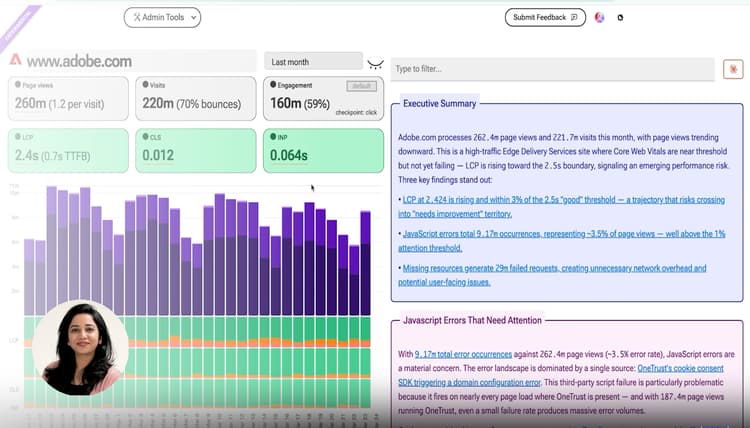
OpTel Detective works directly within the experience you already use. You open OpTel, click the Claude icon, and a few minutes later you have a report. It’s a structured set of findings, ordered by what matters, with each insight linking back to the exact view it comes from so you can move from reading to verifying without losing context. Reports are saved automatically, one per week, in the same date range picker you already use. Each report has its own URL, and anyone with access can open it and see the same output without any additional setup. It works across any site where OpTel is enabled and doesn’t require deep familiarity with the system to get value from it.
Spending months inside OpTel shaped how I read telemetry and how I connect signals into something meaningful. What OpTel Detective does is bring that same process together in one place, combining the reasoning capabilities of the latest models with the patterns that come from working through this data over time. The depth of the experience is still there, but you no longer have to start from scratch. You begin with findings that are already structured, already connected, and already grounded in the data. From dashboard to cockpit to report—the data stays the same. What changes is how quickly you can turn it into something you can use.
If you’re using OpTel today, generate a report for your domain, pick one recommendation, follow it back to the data, and start by fixing it. Because in the end, it’s not just the data you collect, present, or understand, but most importantly, it’s the data that you act on.
For a more detailed walkthrough of how the reports are generated and how the analysis works end-to-end, refer to the official documentation.